Bridging Tradition and Innovation: Jitti Chompee and the Future of Thai Contemporary Dance
Vipavinee Artpradid
(Centre for Dance Research, Coventry University)
Jitti Chompee
(Founder of 18 Monkeys Dance Theatre and Unfolding Kafka Festival)
Tanatchaporn Kittikong
(Associate Professor, Khon Kaen University)
Thai choreographer Jitti Chompee joined Tanatchaporn Kittikong (Associate Professor, Khon Kaen University) and Vipavinee Artpradid (Honorary Research Fellow, Centre for Dance Research, Coventry University) to discuss his evolving approach to contemporary dance in Thailand. Their dialogue explored the relationship between traditional forms, research-led practice, and choreographic development within a shifting cultural landscape.
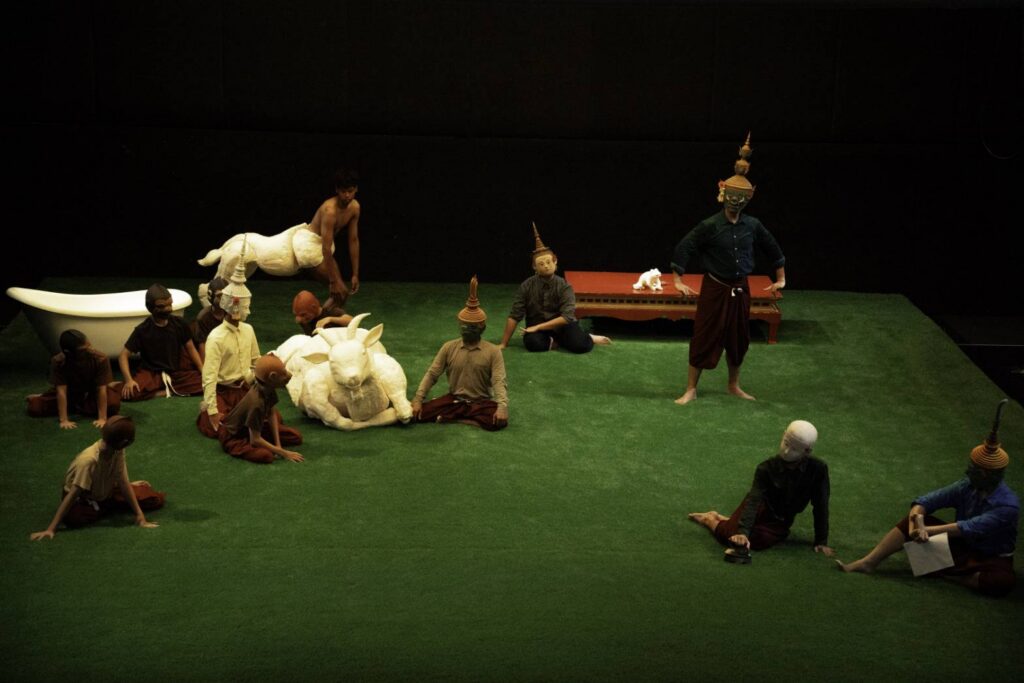
Central to the discussion was Jitti’s project Miscellany of Khon—a book published by the Thai Ministry of Foreign Affairs and the Ministry of Culture. The publication offers a contemporary re-examination of Khon, Thailand’s classical masked dance-drama, through modern choreographic inquiry. Khon “integrates drama, dance, pantomime, and music, with performers wearing ornate headdresses and masks…[performing] the story of the Ramakien – the Thai epic adapted from the Ramayana, the Indian epic” (Kiriwat 2001, Abstract). As the book’s lead contributor, Jitti explained that Miscellany of Khon aims to preserve lesser-known practices within the form while making them accessible to new generations of artists and audiences.
A graduate of The Ailey School in New York, Jitti’s practice is rooted in hybridity, merging Western contemporary techniques with Thai aesthetic and philosophical frameworks. He is the founder of 18 Monkeys Dance Theatre and the Unfolding Kafka Festival, platforms promoting experimental and transdisciplinary performance in Southeast Asia.
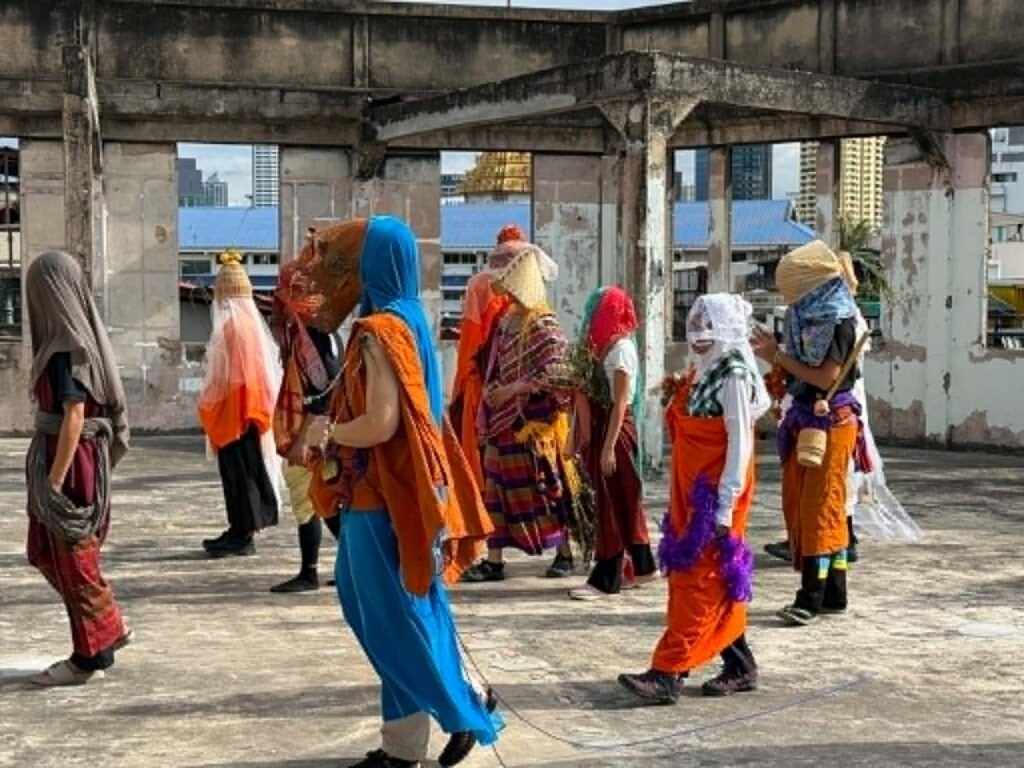
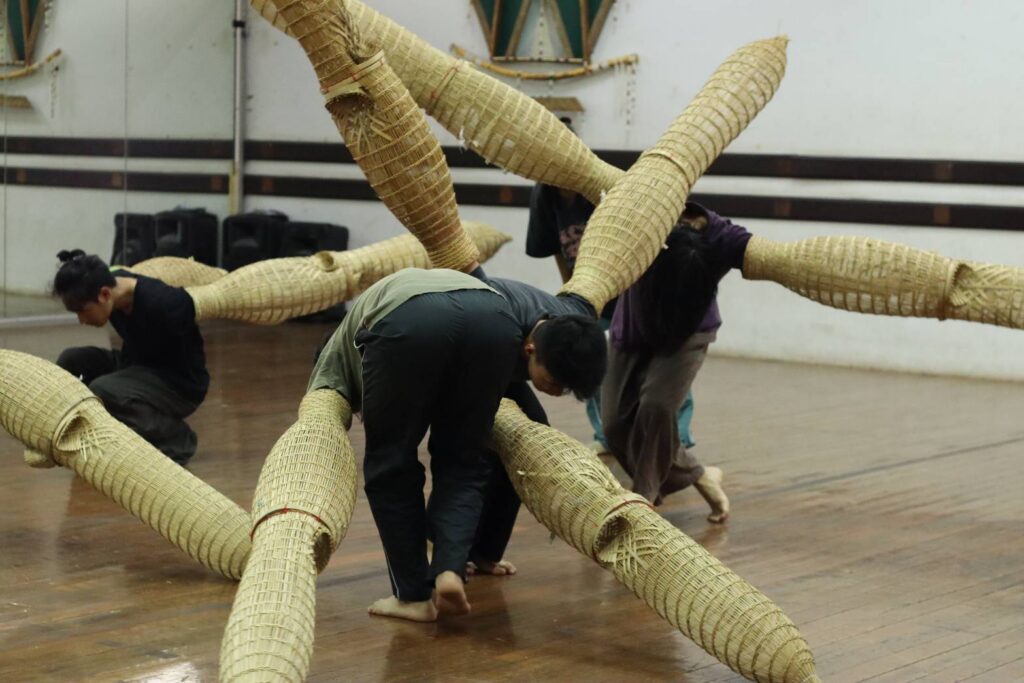
The conversation also emphasized the Khon Kaen Choreography Development (KKCD) initiative, co-led by Jitti and Tanatchaporn. KKCD supports emerging Thai dance and theatre artists through choreographic labs, mentorship, and research-based practice. It encourages critical engagement with both traditional and contemporary forms, fostering innovation grounded in cultural heritage. The programme aims to establish a junior dance company in Northeast Thailand (Isan) and to equip young artists with essential tools in improvisation and choreography (Chompee 2025, Paragraph 1). KKCD operates under Jitti’s artistic direction with support from the Performance Practice Programme, Faculty of Fine and Applied Arts, Khon Kaen University, the Embassy of Spain in Bangkok, the Ministry of Culture (Thailand), and the College of Music, Mahasarakham University.
©Jitti Chompee
On Khon and change
Vip: Is the classical dance form of Khon open to change?
Jitti: Khon is constantly evolving, though not always in ways that align with what we typically associate with contemporary change. It adapts over time, shaped by shifting cultural contexts and audience expectations.While it may appear static on the surface, Khon has been continually reinterpreted in its methods of presentation: the selection of stories, scene structures, musical arrangements, lighting, color, sound, and even the duration of episodes—all these elements shift to reflect contemporary tastes.
It’s not that Khon hasn’t changed; it simply hasn’t changed in the modernist sense people often expect. But make no mistake—it changes all the time.
Tanatchaporn: Your recent work reflects a deep engagement with traditional Thai forms, such as Isan Morlam (Northeastern Thai folk dance) and classical Khon, which you have reimagined through the lens of contemporary performance. In your view, how are these traditional and folk practices evolving within the context of contemporary choreography? And how do you navigate the balance between cultural preservation and creative transformation?
Jitti: I spoke about developing bespoke performances for specific groups of people based on their tastes and local culture. Or creating performances that already exist in other mediums, so the younger generation can build a bridge through classical forms like Morlam and Khon to highlight what they already have.
Morlam doesn’t need to be “spread”—people already know it. What’s concerning is how much it has changed, especially with the younger generation trying to modernize it in ways that imitate Western aesthetics. In the process, many original elements have been lost: the unique sounds, ritualistic aspects, musical textures, and even the distinct typographies and design motifs once used in performance. What’s missing now is an understanding of why things were done a certain way—why certain instruments were played, how particular sounds were produced, and what those sounds meant. The ritual dimension is almost entirely gone. So it’s not about introducing something new, but rather about reintroducing people to what they already have—to restore a connection to the depth and richness that may have been forgotten or overlooked.
If the younger generation becomes aware of these deeper layers, we can help nurture that awareness. I only recently began to realise how many of the ritual elements used in traditional practices overlap with what we now call object theatre. As Myatt (n.d., Abstract) defines it, “Object theatre involves the manipulation of objects to give them life—a reciprocal play between performer and object. It imbues objects and props with significant meanings, implying that it is not only a style of theatre but also a method.” It’s about uncovering the reasons behind specific symbols—why they were created, how they were used, and what meanings they carried. Each province in Thailand has its own unique set of rituals, purposes, and symbols. When we really start to explore, we find that ritual itself is a form of performance. Thailand has 77 provinces, and if we consider all the districts within them, the diversity and richness are immense. This is far too much for any one person to research or revise alone. That’s why we must encourage and support the younger generation to become actively involved in this process of rediscovery and reinterpretation.
Secondly, our classical forms highlight and identify us as being Thai, not Singaporean, not Taiwanese, not Korean, not people doing Western things. It’s a bit like Thai food. People know it as a special type of food. But if we ever go to fusion, it’s over. Fusion food is like the combination of contemporary restaurants with something. If you go fusion, it’s over. It’s dead. It can’t compete with others. It’s not our science. It’s not our environment. It’s not conducive [for us]. But when we support those who have the knowledge that is rooted, it helps in sharing it. It’s not just a science. It has many aspects—music, visual work, protocols, and so many other things.
On Thai audiences concerning contemporary dance in Thailand Tanatchaporn:
Could you talk about the landscape that Thai dance students and practitioners are faced with today?
Jitti: In terms of dance, I can clearly say: there are serious limitations. The limitations are that students and learners in Thailand currently receive no formal education in dance. To be clear, I’m not talking about classical, traditional, or folk dance. In those cases, Thailand is well-equipped. We have schools, great teachers, and government support. So that’s not a problem.
The problem arises when it comes to contemporary dance—it’s a huge issue. We have no personnel who can teach it properly. That’s the first issue. Secondly, we have no platform for people to perform or experience this kind of work on a broader scale. And even if we did have a platform, it still wouldn’t help, because the Thai cultural context is so strong. People just don’t have a strong desire to watch contemporary performances. So, does it need to be developed? Not really. There’s no demand. That’s the simple truth. So, why invest in it?
Vip: So, why do you do contemporary dance?
Jitti: My choreography practice is deeply personal. I enjoy it. I don’t expect others to like it the way I do. I’m simply happy doing the work on my terms, for myself, without imposing it on anyone. But once I began organizing festivals and programs, I started to see more clearly the broader challenges of developing contemporary dance within the Thai cultural context. Are there problems? Yes. But are they serious? Not necessarily. They become problems only if we decide that contemporary dance in Thailand must be developed. If we don’t see it as a priority, then perhaps there’s no problem at all. Is it necessary? Not really. As I’ve said before, what’s the purpose? You could invest a significant amount of resources into this field, but the return might be minimal, simply because not many people are engaged or interested in it to begin with.
Vip: How do you work with people who work in the field of conservation [given your contemporary tendencies]?
Jitti: It’s a creative dialogue—we ask why they did certain things, what they could or couldn’t do. It’s like entering a conversation with them. From there, we select elements that resonate with us, especially those we believe contemporary audiences would connect with. We don’t use what doesn’t belong to us. It’s not just about collecting knowledge—it’s about capturing the essence of each story. That’s how Miscellany of Khon was created. We chose that name because it reflects the fragments we’re drawn to, presented in a way that outsiders can access—something interpretable, open, and easy to engage with.
Tanatchaporn: Based on your experience, what has worked well—and what hasn’t—when it comes to training Thai performance students in contemporary practices?
Jitti: The first thing I focus on is building a foundation for improvisation. Since students don’t yet have the background I do, I start by giving them tools to explore movement on their own—so they can feel it for themselves, rather than comparing themselves to others. They need to develop awareness, to learn to separate and understand different elements within movement. My role is like that of a curator: I invite experienced artists who can help students discover tools that resonate with their unique styles. Each student connects differently, and when the chemistry is right, it helps them find their direction. It’s about guiding them to grow through experience and intuition.
About the Khon Kaen Choreographic Development Initiative
Vip: Could you tell me about the Khon Kaen Choreographic Development Initiative?
Tanatchaporn: The KKCD project officially began in January 2025, following a series of thoughtful discussions between myself, Ajarn Pongsatorn, and Jitti about the possibility of establishing a small dance company in the Isan region. I knew from the beginning that this vision wouldn’t be possible without the involvement of an expert. After years of closely following Jitti’s works, I became convinced that he was the right person to bring this idea to life.
Why a junior company for the contemporary dance scene in Northeastern Thailand? As an academic and researcher in this area, I’ve observed a growing interest in what is often labeled as “contemporary dance”—or more specifically, new hybrid forms of folk/Thai dance. This typically involves blending two or more styles, such as incorporating ballet inspired movements with hand gestures from traditional Thai folk practices or mixing traditional and electronic music. While it shows creativity, it can lead to challenges in educational contexts, where definitions and expectations of dance forms do not always align. One choreographer’s aesthetic understanding of what encompasses contemporary dance may be very different from another’s.
As this trend continues, I’ve noticed that performances have become more focused on surface experimentation—particularly in music and stage design—rather than genuine choreographic development. That said, there has been a positive shift in recent years. More dance educators are now pushing beyond the typical frameworks, using concepts, ritual reinterpretations, and new performance languages to challenge the status quo.
Tanatchaporn: Jitti, as Artistic Director of KKCD, you’ve invited international artists to collaborate with students. Why do you believe this kind of cross-cultural exchange is important?
Jitti: It started off as an itch that had to be scratched, but ultimately it supports the education system [and learning opportunities]. They [the students] can have more references [the artists] than usual, which they would not otherwise have. KKCD is very lucky. The guest artists who have come to teach the students agreed to my invitation, for example, a dance artist from Alain Patel’s Belgian company Les Ballets C de la B., Elie Tass, and Juan Kruz Diaz de Garaio Esnaola.
Vip: What do you see as KKCD’s broader vision and future direction?
Tanatchaporn: In this moment of transformation, I believe it’s the perfect time to bring in someone like Jitti to help redefine and set new standards for contemporary dance choreography in the region. His meticulous attention to detail, aesthetic sensibility, and profound understanding of movement have deeply impressed me. Having had the privilege of observing his training sessions, I’ve seen first-hand what it truly means to choreograph, to listen and respond to music, and to cultivate embodied thinking. It’s no surprise that under his mentorship, students begin to grasp the essence of contemporary performance—not as a trend, but as a deeply intellectual and embodied practice.
Jitti: We’ll see how it goes in this first year and then see its potential. We have to raise the next generation and bring them with us. They’re a bit like a guinea pig. If the process works, it can become a professional set-up.
But if we don’t get the capital, we have to change the approach. It has to be self-made. We have to think beyond the first plan, to the second plan, and beyond the third plan. You have to have it in your head that it can be done and will work, but set a time scale for two years.
“Peculiar beings are bred out of this extraordinary school” – Jitti Chompee
©Jitti Chompee
Biographies
Vipavinee Artpradid
Vipavinee Artpradid’s research applies embodied and inclusive qualitative research methodologies for social change and draws from her background in media anthropology, social anthropology and cultural studies. She has led funded projects on mapping the AHRC-funded Dance Research Matters Networks and with FRONTLINE Dance Company to develop embodied phenomenography for inclusive dance programme evaluation. Her research ‘home’ is the Centre for Dance Research (C-DaRE),
Coventry University.
Jitti Chompee
Jitti Chompee is a Thai choreographer, director, and founder of 18 Monkeys Dance Theatre and the Unfolding Kafka Festival. His works have been presented extensively across Asia and Europe, and he has been commissioned to create new productions by institutions including the Nederlandse Reisopera (Netherlands) and Teatro San Martín (Argentina).
Throughout his career, Jitti has participated in numerous international residency programmes in France, Morocco, and the Netherlands, supported by organizations such as Institut Français, the French Embassy in Thailand, the Kylian Foundation, and Theatre Korzo. His artistic practice focuses on contemporary performance, intercultural exchange, and the reinterpretation of Thai cultural traditions through innovative choreographic approaches.
In recognition of his contribution to the arts and cultural exchange between France and Thailand, he was awarded the title of Chevalier des Arts et des Lettres by the French Ministry of Culture in 2021. He currently serves as Director of the National Choreography Centre of Thailand (NCCT) Project, where he is dedicated to fostering the next generation of choreographic artists and advancing contemporary dance practices in Thailand.
Tanatchaporn Kittikong
Associate Professor Tanatchaporn Kittikong (also known as Or Kittikong) is a theatre and performance educator, researcher, and practitioner at Khon Kaen University, Thailand. Trained in Russia, England, and Australia, her work focuses on bodymind and movement practices, intercultural acting, performance making, somatic and mindfulness-based performer training, and arts education. She is the author of Performance: A Basic Understanding of Performance (2020), the first Thai-language textbook on performance studies, and Fine Arts in the Age of Outcomes: Knowledge, Competency and Holistic Learning in the 21st Century (2026). Her creative and academic works explore contemporary Thai performance, embodiment, curriculum development, and interdisciplinary artistic practice. Tanatchaporn is also part of the National Choreography Centre of Thailand (NCCT) team and co-founder of Khon Kaen Choreography Development (KKCD).
References
Chompee, Jitti. 2025. “The Khon Kaen Choreography Development Initiative.” Page on personal website. Accessed June 21, 2025. https://jittichompee.com/the-khon-kaen-choreography-development/
Chompee, Jitti. (Ed.). 2021. Miscellany of Khon. The Ministry of Foreign Affairs and the Ministry of Culture in Thailand.
Kiriwat, Amolwan. 2001. “Khōn: masked dance drama of the Thai epic Ramakien”. University of Maine Electronic Theses and Dissertations. (631). http://digitalcommons.library.umaine.edu/etd/631 Myatt, Sean. (n.d.) “Foundations for Object Theatre”. Overview of UKRI-funded project on UKRI website. Accessed June 21, 2025. https://gtr.ukri.org/projects?ref=AH%2FI022104%2F1